
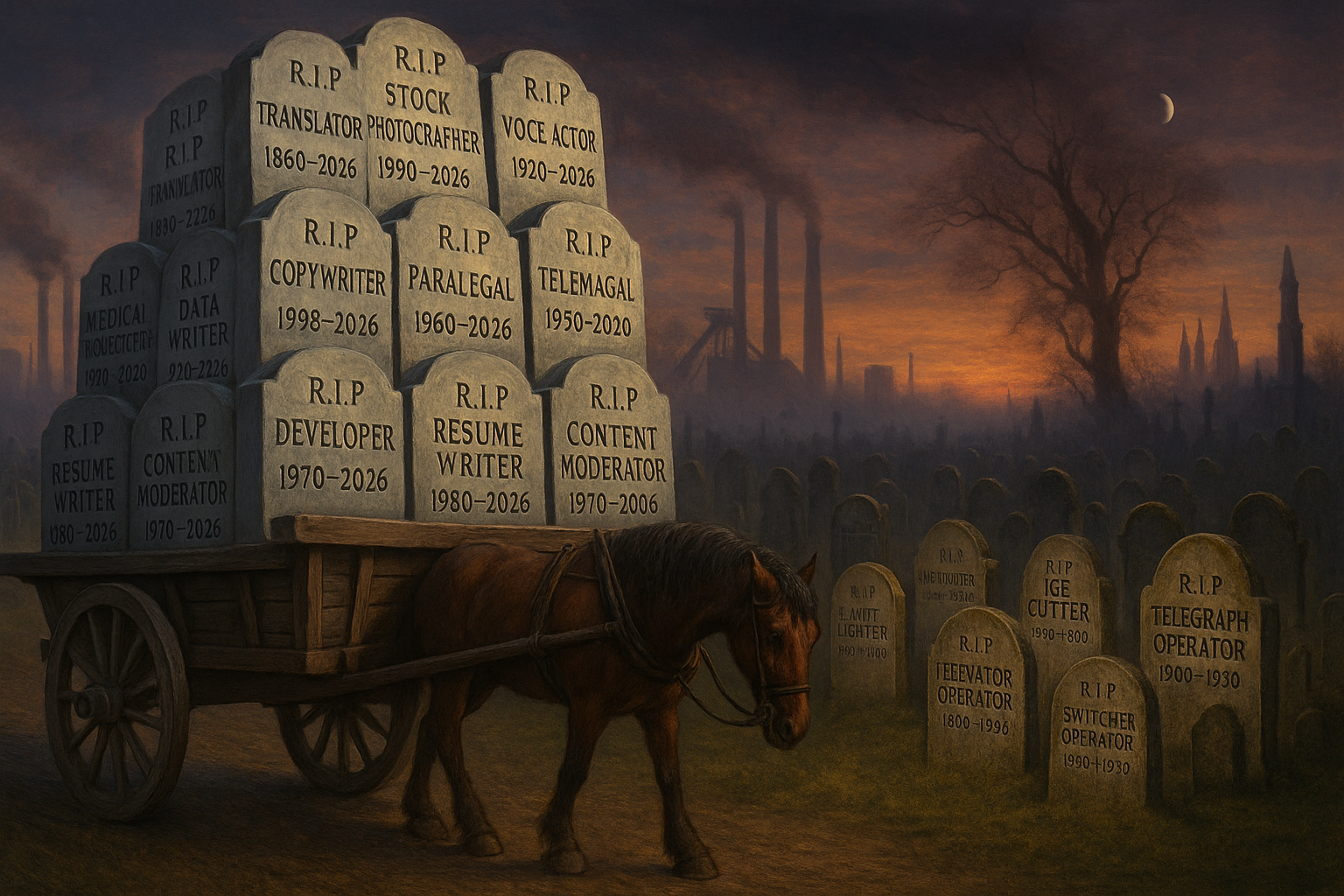
I started building a list of job titles that will not exist by 2030.
The list got longer than I expected. By the time I finished, I needed a cart.
Every industrial wave kills a few job titles
The lamplighter was extinct by 1920. Electricity did it.
The ice cutter ate his last winter around the same time. Mechanical refrigeration did it.
The 1950s killed bowling pinsetters, switchboard operators, milkmen and elevator operators. Automation did it.
The 2000s killed video store clerks, photo lab technicians, music store assistants and toll booth operators. The internet and digital cameras did it.
The 2010s killed cab dispatchers, bank tellers as a mass-market role, DVD rental clerks, encyclopedia editors and Yellow Pages writers. Apps and Google Maps did it.
Each decade, three to seven job titles disappeared. The cart was light.
It got heavier.
The 2020s cart is too heavy for the horse
Here is what is already happening, in commercial deployment, today.
The job title “commercial translator” is going. DeepL and GPT-4 are doing the work for most enterprise translation, and the freelance market has collapsed in 2024.
The job title “stock photographer” went in 2023. Midjourney, DALL-E and Stable Diffusion put a generational creative industry out of work in eighteen months.
The job title “SEO copywriter” is going. The bulk-content shops that wrote thirty articles a day for £15 each closed in 2024 because GPT-4 does it in a minute for free.
The job title “commercial voice actor” is going. ElevenLabs voice cloning broke the e-learning and IVR markets in 2023.
The job title “customer service Tier 1 phone agent” is going. AI voice agents cost less than a tenth of a human and run twenty-four hours.
The job title “paralegal” doing case research is going. Harvey and CoCounsel do the same work in seconds.
The job title “data entry clerk” is going. OCR plus an LLM extracts structured data from any document.
The job title “content moderator” is going. Vision and language models do the work faster, cheaper and without the trauma.
The job title “junior bookkeeper” doing transaction categorisation is going. Modern accounting platforms with LLM integration handle it automatically.
The job title “resume writer” is going. ChatGPT does this in thirty seconds for free.
The job title “medical transcriptionist” is going. Whisper plus a clinical LLM does it in real time.
The job title “annotation worker” labelling training data for AI is going. Synthetic data and self-supervised learning are taking that work.
The job title “junior research analyst” doing information aggregation is going. LLM research workflows are replacing the first-year analyst’s main job.
The job title “manual QA tester” is going. LLM-driven test generation and execution closes the gap.
The job title “technical writer” producing API documentation is going. LLMs generate docs from code directly.
That’s fifteen job titles, in five years, already commercially gone or visibly going. With the rest of the decade still ahead.
Five was the going rate for the worst decade in the past century.
The question I expect from anyone in software
Are programmers next?
Short answer: programmer-as-a-craft is not on the cart. Programmer-as-headcount is.
The job title “software engineer” survives. The judgement, the architecture, the accountability, the system thinking, those are not yet on the cart and may never be.
What is on the cart, this decade:
- The junior developer working on CRUD apps and basic features
- The manual QA tester
- The technical writer documenting APIs
- The frontend developer building simple sites that v0 and Vercel AI can ship in two minutes
- The mechanical code reviewer flagging style issues
If you are a senior engineer with twenty years of judgement, you are safe. If you are a junior with a bootcamp certificate and three years of writing form handlers, the cart slows down for a moment in front of you.
What is actually different this time
The pattern in the past was the same shape repeatedly. A new technology made the manual version of some work uneconomic. Manual telephone switching gave way to automatic switching. Manual typesetting gave way to digital typesetting. Manual elevator operation gave way to automatic elevators.
The pattern this time is different in two ways.
First, the cart is targeting knowledge work, not manual work. The historical waves killed the hands. This wave is killing the early-career mind.
Second, the rate is unprecedented. Translation went from healthy to not-healthy in eighteen months. Stock photography went the same. The historical pattern was extinction over twenty or thirty years. The new pattern is two.
Knowledge work, in two years.
This is not a forecast. This is the trailing reality.
What to do if your job title might be on the cart
Three useful questions.
One: is the work I do the work, or is it the steps toward the work? Manual case research is steps toward the work. Strategic argument is the work. Translating literally is steps toward the work. Translating with cultural judgement is the work. The steps are on the cart. The work is not.
Two: if an AI did 80% of my role in 2027, what is the 20% nobody can do? That 20% is your next title.
Three: am I learning the tool, or being replaced by it? The translator who became fluent with CAT tools in 2005 stayed employed for twenty more years. The translator who refused became unemployed in 2023.
The lamplighter who learned to install electric streetlights had a forty-year career.
The lamplighter who didn’t is on a cart.
What I’m doing about it
I run a small AI consultancy. Most of my work this year has been helping companies figure out which job titles in their own organisation are about to be on the cart, and what the people in those titles can do next.
It is not a comforting conversation. It is a useful one.
If you are wondering whether yours is on the cart, look at the list above and ask the three questions. If you would like to talk through how to make sure the answer is no, I am at oliver@digitalsignet.com.
Either way, the cart is loaded. The horse is moving.